Raid: Shadow Legends explained: mechanics, progression and costs
How this page makes money
This is an advertising-funded page. It contains partner links to the advertiser. If you follow one and register, BAUSTANDARD s.r.o. may be paid a commission by the advertiser. You pay nothing extra and the game itself is free to download either way.
No advertiser has read, approved or paid for the wording of this article, and no payment we receive depends on our being positive about the game. Links that can earn us money are labelled “partner link” wherever they appear. Everything else on this page is an ordinary link. Our editorial policy sets out what we will and will not do.
Raid: Shadow Legends is a turn-based collection role-playing game published by Plarium. It is free to download and monetised through optional in-app purchases and chance-based summoning. This guide describes the systems the game is built from, in plain language, so you can decide whether it is the kind of game you want to spend time on before you install anything.
What this guide is not
It is not written or reviewed by Plarium, and it quotes no drop rates, no player counts and no “best champion” rankings. Those numbers change with every update, and a page that invents them is worse than useless. Where a figure matters, we tell you which in-game screen shows the current value. In case of any divergence between this page and the developer's own information, the developer's information prevails.
What the game actually is
Raid: Shadow Legends is a turn-based fantasy RPG for mobile and PC, developed and published by Plarium. It launched on iOS and Android in 2018 and later added a PC client through Plarium's own launcher. Accounts are shared across platforms, so the same account can be opened on a phone and on a desktop.
The core activity is collecting characters — the game calls them Champions, not “heroes” — and assembling teams of up to five of them to clear content. Battles are not action-based: each champion takes turns in an order determined by a speed statistic, and you choose which of that champion's skills to use on its turn. Much of the content can also be set to run on auto-battle once you have a team strong enough for it.
Two things are worth being clear about up front, because promotional copy often skips them:
- Acquiring champions is chance-based. You do not buy a named champion. You spend a shard on a draw with published odds and receive whatever it gives you.
- Progress is gated by time, not difficulty. An energy meter that refills on a timer limits how much you can play in a day. This is the main thing optional purchases shorten.
Affinities: the one mechanic that decides most fights
Every champion and most enemies have one of four affinities: Magic, Spirit, Force and Void. Three of them form a counter triangle. Void sits outside it and is neither strong nor weak against anything.
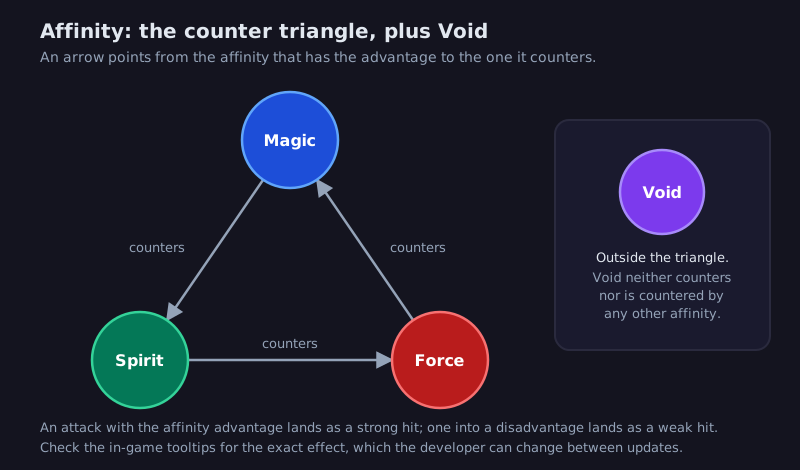
In practice this means a team that is well built but brings the wrong affinity into a dungeon will underperform a weaker team that brings the right one. It is the first thing to check when a stage that “should” be clearable is not. The precise mechanical effect of a strong or weak hit is described in the game's own tooltips, and the developer can adjust it.
Champions: rarity, faction and role
Champions are sorted along three axes at once, and it is easy to confuse them.
- Rarity
- A ladder running from Common through Uncommon, Rare and Epic to Legendary, with a further tier above that added later in the game's life. Rarity caps how strong a champion can eventually become and how expensive it is to build. It is not the same as usefulness: several Rare champions remain genuinely good long after a player can field Legendaries.
- Faction
- A flavour grouping — Banner Lords, Undead Hordes, Dark Elves and so on. Faction matters mechanically in two places: some content requires a full team drawn from one faction, and accessories are faction-bound and only fit champions of that faction.
- Role
- Not a formal label so much as what a champion's skills do: dealing damage, applying debuffs to enemies, applying buffs to allies, healing, or manipulating the turn meter. Teams are built around the effects they need, not around raw power. A team of five damage dealers loses to content that requires a single well-timed debuff.
Seven separate ways to make a champion stronger
This is where new players most often waste resources. Champion power is not one bar. It is seven tracks, each fed by a different resource, and advancing one does not substitute for another.
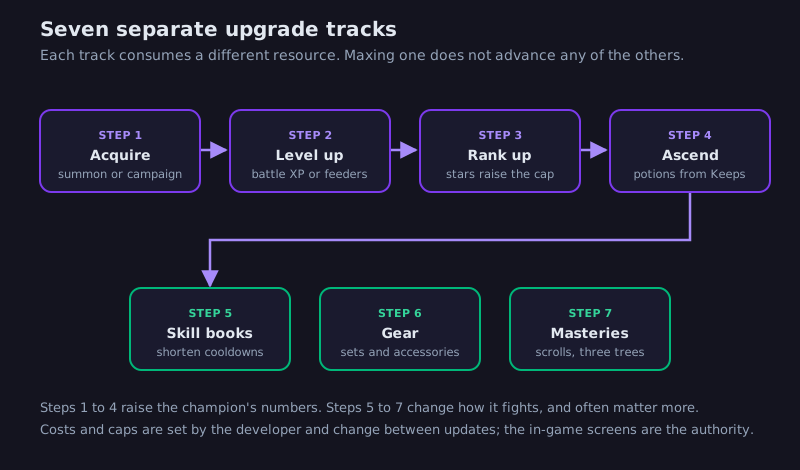
- Acquire — by summoning, or as a reward from campaign and event content.
- Level up — with battle experience, or by feeding other champions in.
- Rank up — each added star raises the level ceiling, and costs other champions as fodder.
- Ascend — consumes potions farmed from the potion dungeons, and unlocks the later parts of a champion's skill kit.
- Skill books — upgrade individual skills, usually reducing cooldowns. For some champions this is the difference between unusable and central to a team.
- Gear and accessories — see below.
- Masteries — a three-tree talent system unlocked with scrolls from a specific dungeon.
The practical consequence: spreading resources across many champions produces a roster of champions that can all do nothing. Building two or three properly, all the way down this list, opens far more content.
Gear, accessories and set bonuses
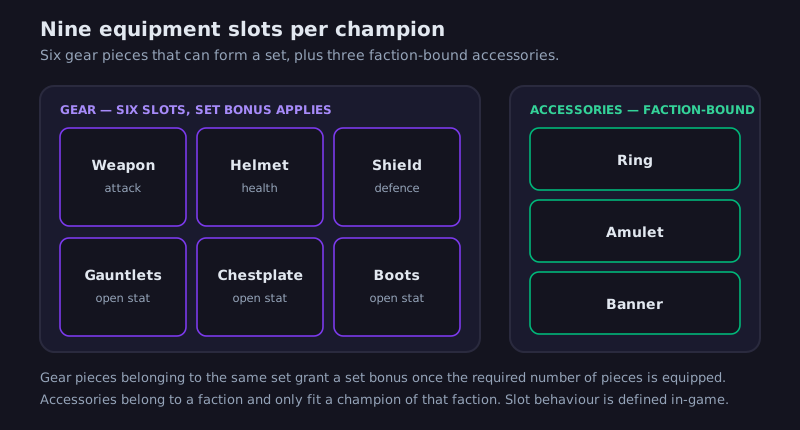
Each champion has six gear slots and three accessory slots. Three of the gear slots have a fixed main statistic; the other three and the accessories can roll a range of them, which is why two otherwise identical pieces can be worth wildly different amounts.
Gear pieces belong to sets. Equipping the number of pieces a set requires grants a bonus — more speed, more critical rate, a healing effect and so on. Two four-piece sets cannot be worn at once on the same champion, so gearing is a series of trade-offs rather than a hunt for the single best item. Speed in particular tends to matter more than raw damage, because the game is turn-based: a champion that acts twice before the enemy does has effectively doubled its output.
Gear is the single largest long-term time sink in the game. It drops from dungeons, it drops with random statistics, and upgrading it consumes silver with a chance of failure at higher levels. Budget for that rather than being surprised by it.
Summoning: what you are actually buying
Champions above the lowest rarities come mostly from summoning. A shard is consumed and a draw resolves. You are buying a draw, not a champion.
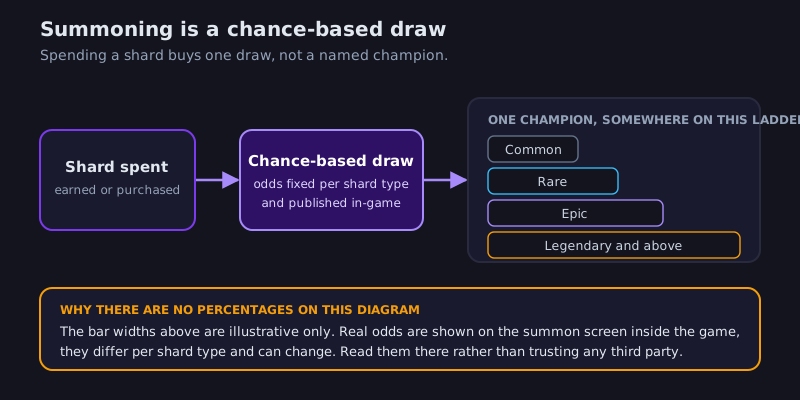
Plarium publishes the summoning probabilities inside the game, on the summon screen itself. They differ by shard type, and the developer can change them. Read them there. We are not going to reprint numbers here that may be out of date by the time you read this, and you should be wary of any third-party page that does.
There is also a mechanism that improves your chances after a long run of unsuccessful draws of a given shard type. The thresholds are shown in the game's own summoning information; we are not quoting them for the same reason.
If you dislike chance-based purchases, this is the game telling you now
Chance-based in-game purchases are the commercial core of this genre, not an incidental feature. Several EU consumer authorities have taken an active interest in how such mechanics are presented and sold, particularly to minors. If spending money for a randomised outcome is not something you want to do, that is a good reason not to start — and a reason to check the parental controls and spending limits on the account before handing a device to a child.
The game modes, and what each one is for
Almost every mode exists to supply a particular resource. Knowing which is which saves a great deal of wasted energy.
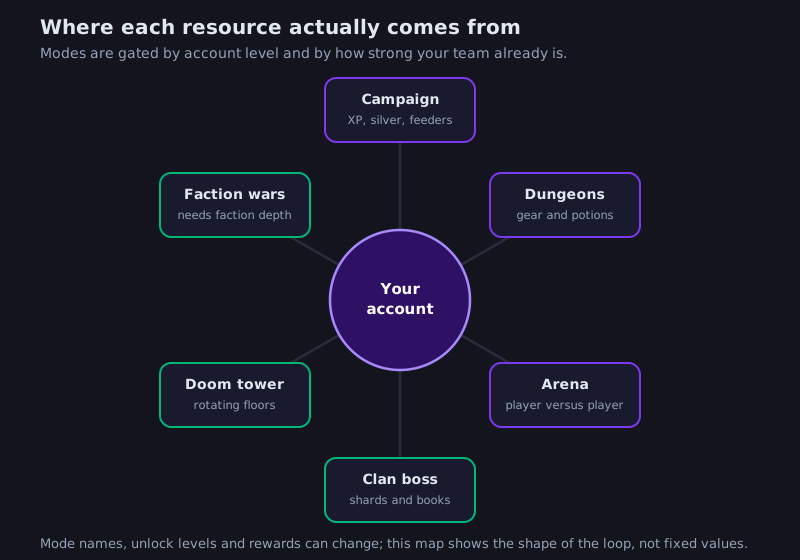
- Campaign — the story content, split into chapters with several difficulty tiers. Mainly a source of experience, silver and fodder champions. Most players end up farming one particular stage repeatedly rather than progressing linearly.
- Dungeons — the gear and potion factories. Each dungeon drops a different kind of reward and each has an affinity or mechanic that punishes the wrong team.
- Arena — player versus player, fought against other players' defence teams rather than against the players themselves. Speed matters here more than anywhere else.
- Clan boss — a shared clan target fought with a limited number of attempts per day. One of the steadier sources of shards and skill books, which is why joining an active clan early is worth more than it looks.
- Doom tower — a rotating multi-floor challenge with bosses that require specific counters.
- Faction wars — requires a full team from a single faction, which is why a roster built only of your strongest champions eventually stalls here.
The daily loop, and what the energy meter is really doing
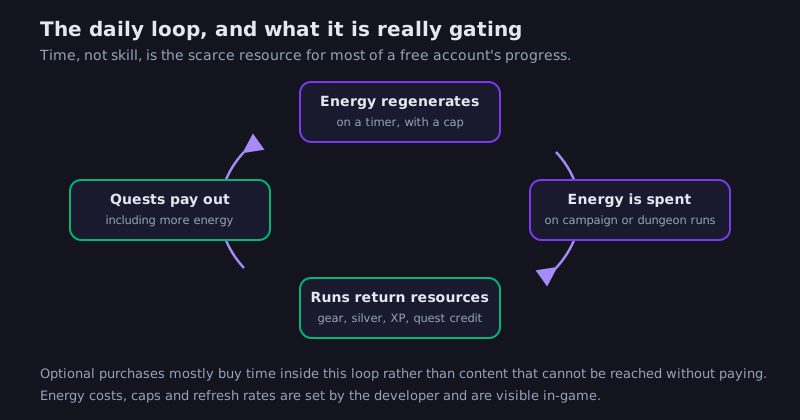
Energy refills on a timer up to a cap, and every battle costs some. Daily and weekly quests hand energy back, which closes the loop. The design consequence is that a free account's progress is paced by how often it can log in, not by how good the player is.
This is also the honest answer to “is it pay to win?”. Almost nothing is locked behind payment. What payment buys is time: more energy, more draws, faster gear. Whether that counts as pay-to-win depends on whether you are competing against other players — in the arena it matters a great deal, and against the game's own content it matters much less.
What free-to-play means here, concretely
The game is free to download and can be played without spending anything. It also sells:
- shards and summoning packs, which are chance-based;
- energy and refills, which buy time;
- bundles combining resources at a stated discount;
- a recurring pass with a reward track.
Prices, contents and availability are set by the developer and by your app store, vary by region, and change frequently. Check them in the store listing rather than anywhere else. If you are setting up an account for a child, set the store's purchase authorisation and spending limits before the first launch, not after.
Platforms, and checking before you install
At the time of writing the game is distributed for iOS through the App Store, for Android through Google Play, and for Windows PC through Plarium's own launcher. Additional storefronts and regional availability change over time.
The store listings carry an age rating — at the time of writing the game is rated for teenagers rather than for young children in the major ratings systems. Ratings are revised and differ by region, so treat the listing for your own region as the authority. The same listing also shows the current download size and the minimum device requirements, which we are deliberately not reprinting: on a game updated this often, a copied specification is a specification that is wrong.
Who it suits, and who it does not
| Likely to enjoy it | Likely to bounce off it |
|---|---|
| Players who like optimising a team on paper — statistics, set bonuses, turn order. | Players who want to sit down for one long session and finish something. |
| Players who are happy with a short daily routine over a long period. | Players who dislike chance-based purchases on principle. |
| Players who will join an active clan and use the co-operative content. | Players who want a story-led single-player RPG with an ending. |
| Players content to progress slowly without spending. | Players who expect competitive parity with paying players quickly. |
This is a partner link. If you register through it, BAUSTANDARD s.r.o. may receive a commission from the advertiser. The game is free to download either way and using this link costs you nothing extra.
A short checklist before you start
- Check the store listing for your region: age rating, size and device requirements.
- If the account is for a child, set purchase authorisation and a spending limit first.
- Open the in-game summoning information and read the actual drop rates before spending anything.
- Join an active clan as soon as the game lets you — it is the largest free upgrade available.
- Pick two or three champions and build them properly rather than levelling everything.
- Decide a monthly budget, if any, before the first bundle appears rather than in response to one.
How we checked this, and our sources
This article describes systems rather than numbers, because systems are stable across updates and numbers are not. Every figure we could not verify at the time of writing has been left out rather than estimated. Specifically, this page contains no drop rates, no player counts, no champion totals, no review scores and no star ratings.
Sources used:
- Plarium's official site for the game and its published game information — plarium.com.
- The game's own in-game information screens, in particular the summoning probability disclosure, which is the authoritative source for drop rates.
- The public store listings on the Apple App Store and Google Play for platform availability, age ratings and pricing.
Where this page and the developer's own information differ, the developer's information prevails. If you find something here that is out of date or wrong, please tell us — our corrections procedure is published, and we will fix it and say that we did.
Trademark notice. Raid: Shadow Legends is a trademark of Plarium Global Ltd. BAUSTANDARD s.r.o. is an independent publisher and is not affiliated with, endorsed by, sponsored by or otherwise connected to Plarium or any of its group companies. All product names, logos and brands are the property of their respective owners and are used here purely to identify the product discussed.
Illustrations. Every diagram on this page was drawn by us specifically for it, as original SVG files served from this domain. No product screenshots, no stock photography and no third-party artwork are used anywhere on this site.
This is a partner link. If you register through it, BAUSTANDARD s.r.o. may receive a commission from the advertiser. The game is free to download either way and using this link costs you nothing extra.